How to Hold a Pickleball Paddle: Grips Explained (2026)
Continental grip is the default. Eastern adds forehand power. Western is rare. How to choose, common grip mistakes, and tennis/badminton transitions.
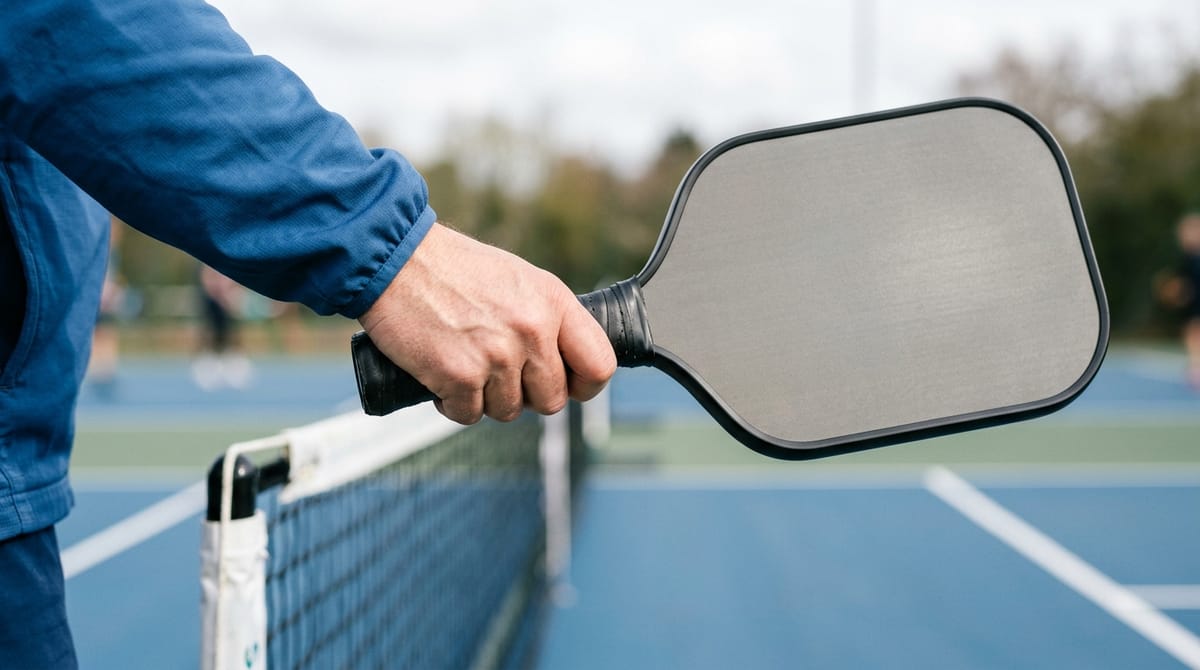
Why does grip matter in pickleball?
Pickleball is played close to the net with a fast back-and-forth rhythm. You don't have time to change grip between a forehand and a backhand the way tennis players do across a 6-metre court. Whichever grip you start with on a rally is mostly the grip you finish with. A grip that works for one shot but breaks down on another costs you points - whereas a continental grip handles every shot in the toolbox with the same paddle position.
Grip also controls paddle face angle at contact. A grip that closes the face means more drives go into the net; a grip that opens the face means more drives sail past the baseline. Get the grip right and the rest of the technique becomes much easier to learn.
What are the three main grips?
Pickleball borrows grip terminology from tennis. The three you'll see in coaching content:
Continental grip (default). Hold the paddle like you're shaking hands with it. The V formed between your thumb and index finger sits on the TOP bevel of the handle (bevel 2 if you number the bevels 1-8 clockwise on a right-handed player's paddle). The paddle face is naturally vertical when your arm is in front of you. Used for serves, volleys, dinks, blocks, and many backhand shots. The most-recommended grip for beginners.
Eastern grip (forehand-dominant). Rotate the paddle in your hand so the V sits on bevel 3 (the upper-right bevel). The face naturally closes slightly when you swing forward - which lets you generate more topspin on forehand drives without manipulating the wrist. The trade-off is that backhands and dinks become harder; you may need to rotate back to continental for those, which is the grip change you want to avoid in a fast exchange.
Western grip (extreme topspin, rare in pickleball). V sits on bevel 4 or 5. The face is almost parallel to the floor when the paddle is held in front. Generates heavy topspin on forehand drives but makes every other shot awkward. Used by a small minority of pickleball players who came from clay-court tennis backgrounds. Most coaches advise beginners to skip this entirely.
How tight should you grip the paddle?
Grip pressure is as important as which grip you choose. Use a 1-10 scale where 1 is barely holding the paddle and 10 is squeezing as hard as you can. The default targets:
Dinks and soft volleys: pressure 3-4. A gentle handshake. Loose grip lets the paddle absorb pace and produces the slow, controlled arc the dink needs.
Returns of serve, neutral rally: pressure 5-6. Comfortable working tension - enough to keep the paddle steady on contact but relaxed enough to adjust quickly.
Drives, put-aways, blocks of hard shots: pressure 7-8. Firm. The paddle does not move on impact even when the incoming ball is fast.
Pressure 9-10 is never correct. Tight grip transmits muscle tension into the paddle face, the ball comes off too fast, and the wrist locks up. If you find yourself squeezing this hard, you're trying to compensate for some other technique issue (poor footwork, late contact, paddle-too-heavy).
The biggest single grip-pressure mistake recreational players make is gripping too hard for dinks. Watch your hand during a long dink rally - if your knuckles go white between shots, drop the pressure to 3-4 and the soft shots immediately become more reliable.
What are the most common grip mistakes?
Grip too tight. Already covered - pressure scale 3-8, never 9-10. The number one issue.
Choking up too far on the handle. Holding the paddle high (closer to the face) reduces leverage and power. The base of the palm should sit at the BOTTOM of the handle for most rallies. Some players choke up for added control on dinks - that's a deliberate technique, not the default.
Letting the V drift to bevel 3 without meaning to. A continental grip slowly rotates toward eastern as your hand sweats and the paddle slips. Re-set between points - look down, check the V is back on top.
Frying-pan grip. Holding the paddle so the face is parallel to the ground (V on bevel 5-6). Almost everyone does this on the first few sessions because it feels intuitive for the dink. It is not a real pickleball grip - drives go straight up, returns go sideways. Re-train as soon as it's pointed out.
No overgrip. The factory grip on a new paddle is smooth and gets slippery as soon as you sweat. A £4-£6 overgrip (the same kind tennis players use) doubles in-rally grip reliability. Most players replace overgrips every 2-3 months of regular play.
Coming from tennis or badminton - what changes?
Cross-sport grip transitions are where most experienced racket players slow themselves down. The mechanics that worked in tennis or badminton don't always carry over.
From tennis: Your eastern or semi-western forehand grip will feel strong on pickleball drives but break down on dinks - tennis players consistently report the soft-game adjustment is the hardest part of the transition. Train yourself to use continental for everything inside the kitchen zone (see our kitchen rules guide). Save the eastern forehand for baseline drives only.
From badminton: Badminton uses an even shorter grip and almost zero wrist break for clears/drops. The grip strength is closer to pickleball's continental than to tennis's stronger grips - badminton players adapt quickly to dinks and volleys. The thing to retrain: the badminton wrist-snap on smashes is the wrong motion for pickleball drives, which use shoulder rotation more than wrist.
From table tennis: The pen-hold or shake-hand grip is close enough to continental that little adjustment is needed. The bigger gap is wrist mechanics - table tennis uses a lot of wrist; pickleball uses much less.
From squash: Squash uses a continental grip already; the transition is the smoothest of any racket sport. The retraining target is shot pace - squash punishes power; pickleball rewards finesse, especially at the kitchen line.
When should you change grips during a rally?
The short answer for recreational players up to 3.5 level: don't. Pick continental and stay on it for the entire point. The time it takes to rotate the paddle in your hand is the time you don't have when a ball is coming at you from 5 metres away.
Advanced players (4.0+) do switch - typically continental for serves, returns, and the kitchen line, then a brief rotation to eastern when stepping back for a forehand drive in the transition zone. They make the switch DURING the recovery between shots, not at contact. If you're not yet doing that consistently, single-grip play is more reliable.
Frequently asked questions
Should I hold the paddle with two hands like a tennis backhand?
What if I'm left-handed?
Does the grip change for serves vs returns vs dinks?
How often should I replace the overgrip?
Does the paddle's grip size matter?
Is the continental grip the same as the 'handshake' grip?
- How to dink in pickleball - where loose grip pressure (3-4) matters most.
- How to serve in pickleball - the continental grip handles every serve type.
- Pickleball kitchen rules - the zone where grip pressure matters most.
- Pickleball rules explained UK - full rules reference.
- Best pickleball paddle for beginners UK - paddle picks with grip-size guidance.