How to Dink in Pickleball: Technique and Drills
Pickleball dink shot tutorial: continental grip, contact ahead of body at knee height, paddle face slightly open. 5 drills inside.
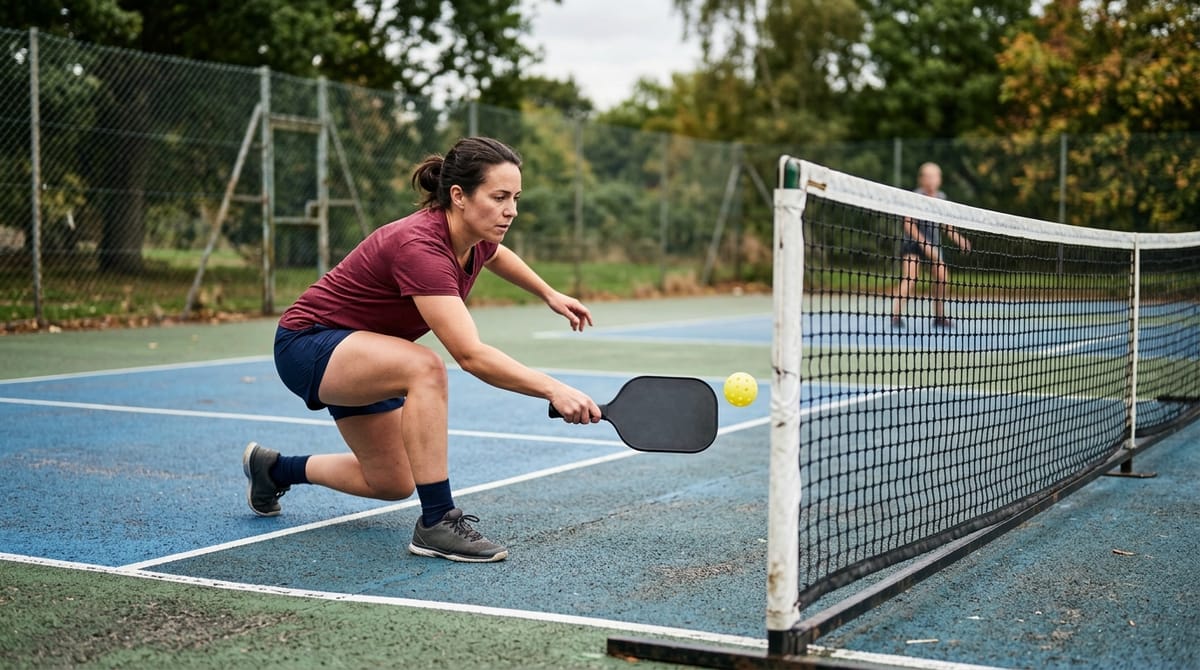
What is a dink shot?
A dink is a soft shot hit on the bounce from inside or near your own non-volley zone (the kitchen - the 7ft area on each side of the net, see our kitchen rules guide). The dink arcs over the net and lands inside the opponent's kitchen, forcing them to hit upward off a low bounce. The point of a dink is patience: you remove the opponent's chance to attack while you wait for a ball you can finish.
Tactically, the dink is half of pickleball's soft game (the other half is the third-shot drop). Recreational players who can dink reliably for 6-10 shots in a row win significantly more points at the 3.0-4.0 skill level than players who try to drive every ball - because the dink rally invites the opponent to make the first unforced error.
How do you grip the paddle for a dink?
The continental grip (sometimes called the "hammer grip") is the dominant choice. Hold the paddle as if you're shaking hands with it, with the V between your thumb and index finger sitting on the top bevel of the handle. The paddle face naturally angles slightly open in this grip, which is what you want - a slightly open face produces a higher arc with less power.
Loose grip pressure matters more than the exact grip you choose. On a scale of 1-10, dink with grip pressure 3-4 (gentle handshake), NOT 8-9 (squeezing for a drive). Tight grip transmits muscle tension into the paddle face, which causes the ball to come off too fast and land deep. A loose grip lets the paddle absorb pace and "drop" the ball softly.
Where does the ball make contact?
Three contact-point rules govern a reliable dink.
Contact in front of your body. The paddle should meet the ball roughly 30-45cm ahead of your front foot, not beside or behind you. Late contact forces a wrist-flick that adds pace - which kills the soft shot.
Contact around knee height or below. A dink is hit off a bounce that comes up no higher than your knees. Anything higher than that is an opportunity for a roll volley or a put-away, not a dink.
Paddle face square or slightly open. Closed face (pointing down) causes the ball to hit the net. Wildly open face (pointing up) sends the ball deep past the kitchen. Imagine the paddle face as a small ramp angled at 10-20 degrees toward the sky - that's the geometry.
What's the swing motion?
The dink swing is short, smooth, and originates from the legs and shoulder - never the wrist. Three components:
- Drop your centre of gravity. Bend the knees so the paddle is naturally near where the ball will arrive. Trying to dink from a standing-tall posture forces you to reach down with the arm and you lose control.
- Low-to-high lift from the shoulder. The paddle starts below the contact point and brushes upward through the ball in a short arc, maybe 30-40cm of total motion. The shoulder rotates; the wrist stays firm.
- Follow through toward your target. A short follow-through ending around chest height (paddle pointing at where you want the ball to land) is plenty. Long follow-through adds power - which is exactly what you don't want.
Where should the dink land?
The default target is the centre of the opponent's kitchen, 1-2 feet inside the kitchen line. The reason for that depth: a ball that lands at the very front of the kitchen (right by the net) often pops up too high after the bounce and becomes attackable. A ball that lands too close to the kitchen line gives the opponent room to step in and volley before the bounce, which is the put-away you don't want to set up. Centre-of-kitchen depth gives the lowest bounce-height and forces the opponent to dink it back.
As you advance, dink placement variation matters more: cross-court dinks (longer travel = more time to recover), down-the-line dinks (shorter, riskier, but cut off the opponent's lateral movement), and "backhand-side dinks" (most players' weaker shot - target it). Recreational up to 3.5 level: just land it consistently inside the kitchen for now.
Five drills to ingrain the dink
Drop-and-dink (solo). Stand at your kitchen line. Drop the ball, let it bounce once, dink it over into the opponent's kitchen. 50 forehands, 50 backhands. The goal is purely about contact point and paddle face - no movement required.
Crosscourt cooperative dink (partner). One person on each diagonal corner at the kitchen line. Dink crosscourt back and forth, aiming for a sustained 10-shot rally. When you miss, count starts over. This drill rewires the brain to hit slow, not fast.
Down-the-line cooperative dink (partner). Same drill, but dinking straight ahead instead of crosscourt. Down-the-line dinks are shorter, faster, and harder to control - this drill targets the geometry that breaks down most often in match play.
Dink-to-volley (partner). You dink, the partner volleys the ball softly back into your kitchen, you dink again. This bridges from dinking practice to real-match patterns where some balls will be returned as volleys rather than off-the-bounce shots.
Attack-the-attackable (partner). Dink rally with one rule: if a dink pops up above net height, the receiver must attack it (with a roll volley or speed-up). This trains both players to recognise the moment when the soft game gives way to the hard game.
What are the most common dink mistakes?
Wristing the ball. The wrist breaks at contact, adding pace and sending the ball deep or wide. Fix: imagine the wrist is in a splint - shoulder rotates, wrist stays.
Standing tall and reaching down. The paddle drops below the body line and the arm has to scoop. Fix: bend the knees - lower the centre of gravity, not the arm.
Hitting too hard. Easy to do when adrenaline rises in a rally. Fix: pick a target the size of a dinner plate inside the opponent's kitchen and aim for it, not over it.
Backing off the kitchen line. When the ball gets uncomfortable, the instinct is to retreat. That's exactly when the opponent attacks - you've created the gap they wanted. Fix: stay glued to the kitchen line and play the next ball calmly.
Stopping watching the ball at contact. The eyes drift to the opponent's position too early, head lifts, contact deteriorates. Fix: watch the ball onto the strings; lift the eyes only after the follow-through has started.
Frequently asked questions
Should I dink with topspin or flat?
Can I dink from the baseline?
How is a dink different from a drop shot?
Why does the ball keep going into the net?
What paddle is best for dinking?
- Pickleball kitchen rules - the 7ft zone the dink lives in (and the rules that govern it).
- How to serve in pickleball - the start of every point.
- Pickleball rules explained UK - full rules reference, helpful when you're learning the soft-game patterns.
- Best pickleball paddle for beginners UK - touch-oriented paddle picks for new players.