Pickleball in the UK: The Complete Beginner's Guide
How pickleball works, where to play in the UK, the rules that actually matter, and what to avoid in your first three months on court.
Pickleball is the fastest-growing paddle sport in the UK in 2026 - over 40,000 active players, 3,000+ entering this year's English Open, and dedicated courts opening at clubs and leisure centres faster than the directories can update them. This guide is the orientation piece for someone who has never picked up a paddle: what the game actually is, the rules that matter in your first three months, where to play in the UK, what equipment to start with, and the beginner mistakes worth avoiding before they put you on a six-week injury layoff. By the end of it you will know enough to walk into a session and play.
This site has companion guides on specific topics - paddle reviews, court directories, drills, rule deep-dives - but this is the one to read first.
1. What is pickleball, actually?
Pickleball is a paddle sport invented in 1965 on Bainbridge Island in Washington State, USA. The format combines elements of tennis (the rally structure and side-out scoring), badminton (the court size - pickleball uses exactly the same 6.1m × 13.4m footprint as a badminton court) and table tennis (the paddle technique and ball speed). The ball is a hard perforated plastic sphere broadly similar to a wiffle ball - slow enough that long rallies and tactical placement matter more than raw power, fast enough that anything above casual recreational level is athletic.
The game is played as singles or doubles, with doubles overwhelmingly the dominant format socially and at all UK club nights. Most newcomers start with doubles because it spreads court coverage across two people and the conversation between rallies is half the appeal. Competitive singles exists at tournament level and is closer to fast-paced tennis on a small court.
What makes pickleball distinctive among racket sports is the deliberate slowing-down imposed by two rules: the kitchen (also called the non-volley zone) prevents anyone from standing 7 feet from the net and smashing volleys, and the two-bounce rule forces the serving team to let the return bounce before they can attack. These constraints turn the early phase of every point into a soft-control game - "dinking" rather than smashing - which is what produces pickleball's particular rhythm and what makes it accessible to people who have never played a racket sport.
2. How pickleball is growing in the UK
The UK pickleball scene has gone from a niche imported curiosity to one of the fastest-growing sports in the country in the space of three years. The official governing body, Pickleball England, is now recognised by Sport England and describes pickleball as "one of the fastest-growing and most inclusive sports in the country."
The scale numbers as of mid-2026:
- 40,000+ active UK players with reported 65% year-on-year membership growth (industry figures via The Kitchen Pickle).
- 73% growth in registered Pickleball England players during 2024 alone.
- The English Open has gone from 305 players and 694 event registrations at its inaugural running to 2,350 players / 4,321 registrations in 2025, with the 2026 event already at 2,900+ registered and forecasting 3,200-3,500 participants.
- 270+ pickleball venues across the UK as of 2026 (a mix of dedicated and shared-use facilities).
- For perspective: England alone now has more than triple the 12,000 pickleball players that existed across all of Europe in 2020.
What this means practically is that finding a session is much easier in 2026 than it was even a year ago, and that the social side of the sport - turn-up-and-play club nights, mixed-doubles sessions, beginner-friendly leagues - is healthier than the venue infrastructure on its own would suggest. The sport is also growing across age brackets in a way most racket sports are not; older players who left tennis behind years ago find pickleball physically manageable, and a younger generation has arrived via padel-adjacency.
3. The rules - what you need before your first session
The official rules are the USA Pickleball Official Rulebook, which the International Federation of Pickleball (IFP) and Pickleball England both adopt for UK club and sanctioned play. The condensed version that matters for your first three sessions is below; for the full rulebook with FAQs, faults and recent changes see our complete UK pickleball rules guide.
Court
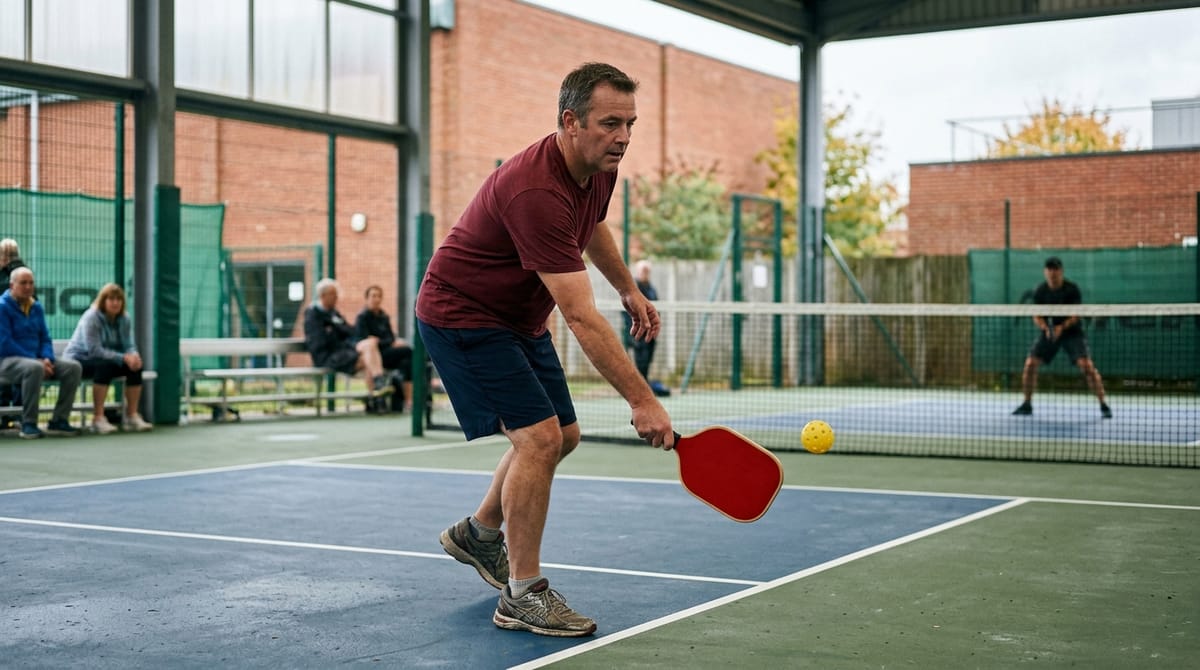
A pickleball court is exactly badminton-sized - 6.1m wide × 13.4m long - with a tennis-style net at 36 inches high at the sidelines and 34 inches at the centre. Either side of the net is a 7-foot non-volley zone (the kitchen). The remaining court on each side is split into a left and right service box by a centre line.
Serving
The serve is underarm, hit with the paddle below waist height, from behind the baseline. It must travel diagonally and land inside the opponent's service box on the far side. Only one serve attempt is allowed (no "second serves" as in tennis). In doubles, each team gets serves from both partners before the side-out - except at the very start of the game, when only the first server of the starting team serves before the side-out (this is the "0-0-2" call you will hear, which means it is the second server's turn - actually the first server, because the starting team gets only one).
The two-bounce rule
This is the rule that catches every newcomer. After the serve, the receiving team must let the ball bounce once before returning it, and on the return shot, the serving team must also let it bounce. Only from the third shot onward can either side volley (hit the ball out of the air). The point of the rule is to prevent the serving team from rushing to the net and smashing, which would make serving an overwhelming advantage.
The kitchen (non-volley zone)
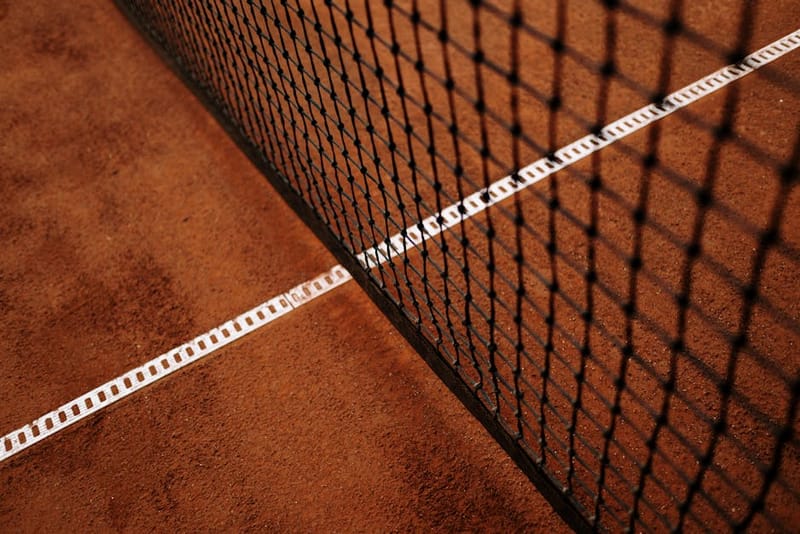
You cannot volley a ball while any part of your body is touching the kitchen - including the kitchen line itself. You can step into the kitchen at any time, but you cannot hit a volley from there. If you volley and your momentum then carries you into the kitchen, that is also a fault. The kitchen is where the soft control game ("dinking") happens; the line is a hard constraint.
Scoring
Traditional pickleball scoring is side-out: only the serving team can score points. A game is played to 11, win by 2. The score is called as three numbers in doubles - "server score, receiver score, server number (1 or 2)" - for example, "5-3-2" means the serving team has 5, the receiving team 3, and it is the second server's turn. Tournament play sometimes uses 15-point or 21-point games, and a rally-scoring variant exists, but recreational play is overwhelmingly traditional 11-point side-out.
4. Where to play in the UK
Finding a session is the practical question for any new player. UK pickleball venues fall into three categories:
- Dedicated pickleball clubs and centres - growing fast but still a minority of UK venues. Examples include Courtside Pickleball in Stourbridge, Dinks Pickleball Clubs in Chandlers Ford, and several London-area dedicated facilities that have opened in 2025-2026.
- Converted badminton-court sessions - the dominant model in 2026. Leisure centres and sports halls run "pickleball sessions" using portable nets and temporary kitchen-line tape on badminton courts. The conversion is fast (the dimensions are identical), the equipment is provided in many cases, and the cost is the lowest entry point.
- Club-night sessions at tennis or racket clubs - a hybrid where an existing racket club has added pickleball to its programme using its own indoor or outdoor courts. Best for finding regular partners and beginner coaching.
Major UK directories and locators
- Pickleball England Club Locator - the official directory maintained by the governing body, sorted by region.
- Pickleball England Outdoor Courts - separate directory specifically for outdoor venues. Useful in summer; thin in winter for obvious reasons.
- LTA's pickleball pages - coverage of LTA-affiliated tennis clubs that have added pickleball programming.
- Pickleheads - third-party directory with the largest single-platform UK coverage (28 locations / 106 courts in London alone - 82 indoor, 24 outdoor).
- Pickleball Social - London-focused club hosting sessions at Bermondsey, Bromley, Clapham, Battersea, Dulwich, Richmond and Kensington.
- Better Leisure - has rolled out pickleball at 20+ London leisure centres from Croydon to Barnet to Leytonstone.
- Dink Quest - third-party directory with strong coverage of Manchester, the North West and the Midlands.
For a brand-new player in 2026, the recommended starting path is: search Pickleheads or Pickleball England for clubs within 20 minutes of home, pick one that explicitly markets a "beginner" or "introductory" session, turn up with sensible court shoes and water. Most clubs lend paddles for the first session free of charge - there is no need to own equipment before knowing whether the sport is for you.
5. Equipment - what to buy and what to skip
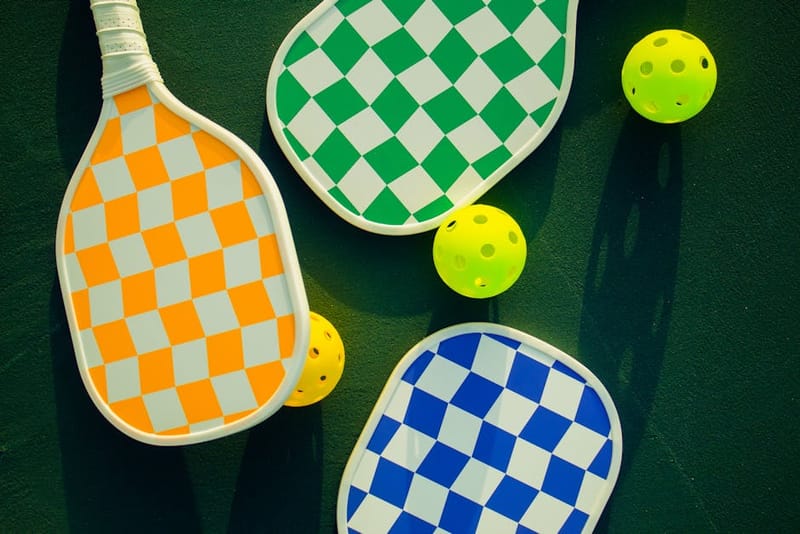
Pickleball equipment is mercifully simple. The minimum kit is a paddle, balls, court shoes and water. Detailed paddle reviews live in our gear guides; the principles for a first paddle are:
- Spend £40-£80 on a beginner paddle. The £150-£250 elite paddles are real and noticeably better, but the difference is almost entirely beyond a beginner's ability to exploit. The £40-£80 band is where well-made fibreglass-faced paddles with comfortable grip sizing sit.
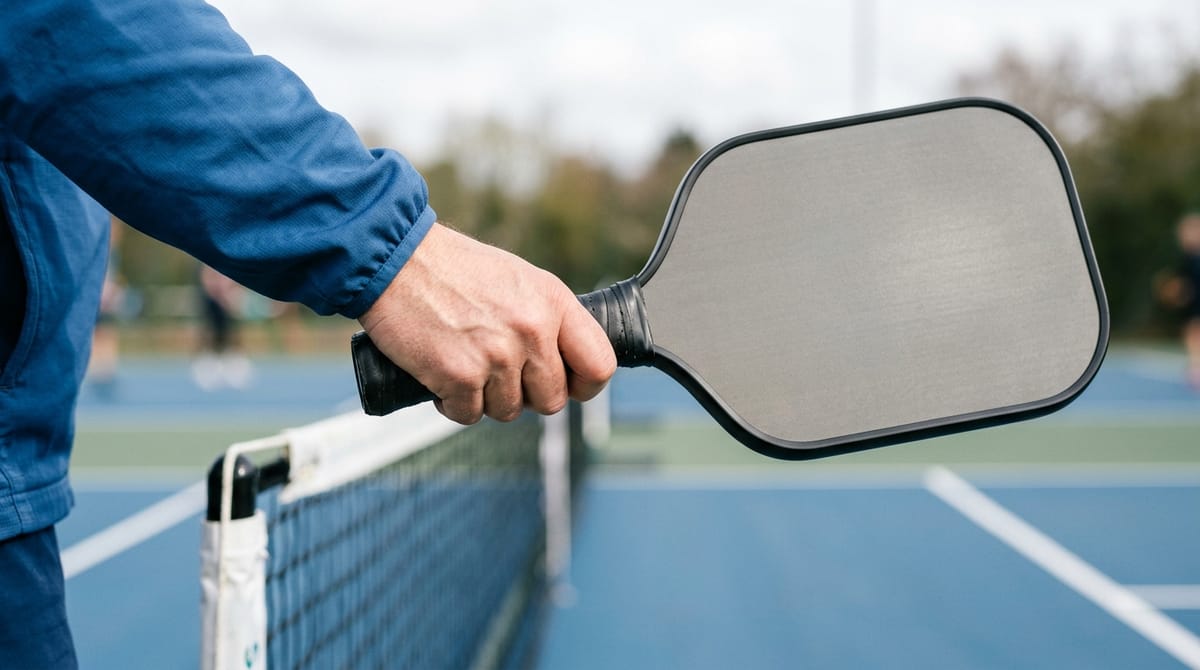
- Grip size matters more than face material. Standard grip circumference for adult hands is roughly 4 1/4" to 4 1/2". Too-small grips cause the wrist to over-rotate and drive pickleball-elbow injuries; too-large grips cause clumsy ball contact. Most retailers will let you measure.
- Paddle weight should be 7.5-8.5 oz for most beginners. Heavier (8.5-10 oz) hits harder but is more fatiguing and more injury-inducing for new players; lighter (under 7.5 oz) reduces arm load but lacks power.
- Indoor and outdoor balls are different. Outdoor balls are smaller-holed, harder and denser; indoor balls are larger-holed and softer. Most courts will tell you which to use; some venues provide them.
- Indoor court shoes only. Non-marking soles, lateral support. Running shoes are a recipe for ankle injuries - the lateral movement in pickleball is closer to badminton than to running. A pair of basic indoor court shoes is £40-£70.
What to not spend money on as a beginner: a £200+ premium paddle, multiple paddles for different conditions, branded apparel, paddle-grip overwraps in excess. The single highest-value upgrade after your first month is a slightly heavier paddle if you have built the conditioning to swing it - but defer that decision.
A kit bag is optional at this stage too - a normal backpack works - but once you are carrying a paddle, balls, water and indoor shoes to two sessions a week, a purpose-made pickleball bag starts to earn its place.
6. Beginner mistakes that cause injuries
Pickleball is generally low-impact for a racket sport, but it has one signature injury - "pickleball elbow" - that almost everyone encounters if they play hard for several months without managing technique and volume. Harvard Health's 2023 review is the clearest medical summary of the condition: it is tendinitis caused by gripping the paddle too tightly or repeatedly twisting the wrist at ball contact, which "creates tiny tears in the tendons attaching the extensors to your elbow."
The Harvard review identifies the dominant risk factor as new players who "go from zero to 100 too quickly, and aren't ready for it physically." Once you have pickleball elbow, the standard medical recommendation is to stop playing pickleball for about six weeks. That is a significant cost in time, social connection and momentum - and it is largely avoidable.
The practical mitigations, in rough order of importance:
- Build up volume gradually. Two sessions per week for the first month. Three per week in month two. Four per week thereafter only if your arm is comfortable.
- Grip the paddle loosely. The standard wisdom is to grip at maybe 4 out of 10 in tension - firm enough to control the paddle, loose enough that the muscles of the forearm are not constantly contracting. The grip should tighten only at the moment of ball contact.
- Use two hands on the backhand - Harvard Health specifically calls this out as reducing forearm and elbow stress. The two-handed backhand is harder to learn but a smaller injury surface.
- Warm up before play. Five minutes of gentle dinking and shadow swings is enough. The cold-start ball is the one that causes the tear.
- Avoid wrist-flicking at contact. Swing from the shoulder, not the wrist. This is also better technique - wrist shots are less accurate.
- Match paddle weight to your condition - a 10 oz paddle in a player not yet conditioned for it accelerates the injury timeline.
- Take a rest day after intense sessions. Two-day-old fatigue is the period of highest injury risk.
Beyond elbow, the other common pickleball injuries are ankle sprains (lateral movement on poor court shoes), Achilles tendon issues (sudden starts and stops without conditioning), and shoulder rotator-cuff irritation (over-reaching for overhead shots). The mitigations are the same: gradual volume build-up, appropriate equipment, technique that uses the whole body rather than the arm alone.
7. The social side and finding regular partners
The most underrated part of UK pickleball is the social model. Most club nights run as "round-robin" sessions - you turn up, you play a short game (often to 7 or 9 points to keep matches moving), you rotate partners and opponents, and you are pencilled in for the next available court. The single round-robin format is what makes the sport unusually welcoming to solo newcomers; you do not need to bring a partner or a group to participate.
The natural progression for a UK beginner from week 1 to month 6 typically looks like:
- Weeks 1-3: Drop-in sessions at the nearest leisure centre or club beginner night. Borrowed paddles. Watching more than playing.
- Weeks 4-8: Bought your own £40-£80 paddle. Twice-weekly sessions. Starting to recognise other regulars.
- Month 3: Joined a club. Started entering casual round-robin tournaments at the venue. Possibly taken one or two private or semi-private coaching sessions to fix grip and technique.
- Months 4-6: Entered a county-level league or a local ladder. Considering a paddle upgrade. Helping new beginners through the same path.
This is a slower curve than the marketing tends to suggest, but it is the one that produces players who are still playing in year three. The fast trajectory - five sessions a week from week one, premium gear from day one, competitive league entries before basic technique is settled - is the trajectory that produces the six-week injury layoff.
From social sessions to organised play
Once you have a regular game, the next steps are usually organised play. Three guides cover that ground:
- Entering your first tournament - what the formats and ratings actually mean, and what to expect on the day.
- Winter indoor leagues - how UK play moves indoors from autumn, and how to find a league place.
- Starting a club - for when the nearest session is too far away and the answer is to run one.
Going deeper on the rules and the vocabulary
Section 3 covers what you need to walk on court. When you want the detail, these go deeper on one thing each:
- Serve rules and faults - the serve is where beginners concede most free points, and where the rulebook is fussiest.
- Court dimensions - useful if you are marking out a court or checking whether a badminton hall will work.
- Glossary of terms - dink, kitchen, stacking, Erne. Worth a skim before your first social session.
- Singles strategy - for when you play the one-on-one format, which asks quite different things of you than doubles.
Frequently asked questions
How is pickleball different from padel?
Do I need a partner to start playing in the UK?
How long does it take to learn pickleball?
How much does pickleball cost to get into in the UK?
What is the kitchen and why does it matter?
Is pickleball safe for older players?
Can I play pickleball outdoors in the UK?
Found a session? Browse our other UK pickleball guides next
Detailed paddle reviews, rules deep-dives, regional court directories, and beginner-friendly drills - everything to follow up on once you're past your first three sessions.
Keep learning: your beginner pathway
Everything else a new player needs, in the order most people need it.
Pickleball Rules Explained
Scoring Explained
How to Serve
The Kitchen Rules
How to Hold Your Paddle
Beginner Drills
Pickleball Etiquette
Best Beginner Paddles