Pickleball Kitchen Rules: The Non-Volley Zone Explained
Pickleball kitchen rules explained: what counts as 'in the kitchen', momentum faults, the volley rule, 4 common misconceptions.
The kitchen (non-volley zone, or NVZ) is the single most-faulted area in pickleball. Beginners typically commit 5-10 kitchen faults per first session. Intermediate players (3.0-3.5) still commit 2-3 per session as the momentum rule catches them mid-volley. This tutorial covers what the kitchen actually is, what's legal, what's a fault, and the four common misconceptions that produce most of those faults.
What is the kitchen (non-volley zone) in pickleball?
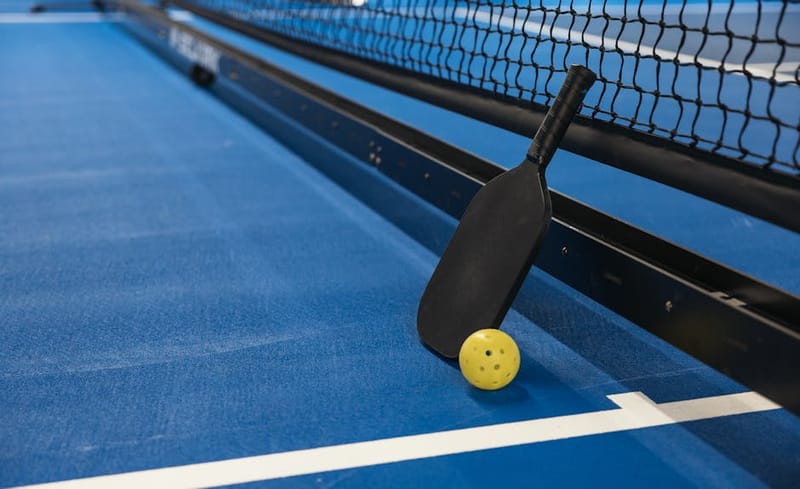
The non-volley zone is a 7-foot zone on each side of the net, marked by the kitchen line parallel to the net. It extends across the full width of the court. The kitchen line itself is part of the kitchen - touching the line counts as being in the kitchen.
Vertically, the kitchen extends infinitely upward (in the rules sense). The kitchen volume includes the air space above the kitchen floor. This matters for the 'momentum' interpretation - if you volley a ball while standing outside the kitchen but your follow-through swing crosses INTO the kitchen's air space, it's still a fault if any part of your body enters the kitchen before you return to the non-kitchen ground.
The opposite is also true: you can be inside the kitchen (post-bounce) and hit the ball UPWARD into the kitchen air space without faulting. The rule is about volley-related actions, not air-space presence per se.
What can you legally do in the kitchen?
Stepping into the kitchen to play a ball that has already bounced. Once the ball has bounced, you can step in, play it, and stay in the kitchen for as long as you need. The 'never enter the kitchen' misconception is wrong - you can be in there constantly during normal rallies.
Standing in the kitchen if the ball is at the back of the court. There's no rule that says 'you can't be in the kitchen when the ball is in play'. The restriction is specifically on volleying.
Returning to the kitchen for the next ball after stepping out. No 'cooldown' rule - you can dance in and out of the kitchen as the rally dictates.
Reaching over the kitchen line with your paddle to hit a ball IN the kitchen air space, as long as your feet are outside. If you can reach without crossing into the kitchen with your body, that's legal.
Hitting a ball that bounces ON the kitchen line. The kitchen line is part of the kitchen for the purpose of where balls land - so a ball on the line means it bounced in the kitchen. Once bounced, you can play it normally.
What counts as a kitchen-rule fault?
Volleying with any part of your body touching the kitchen line or kitchen floor. If your foot is on the line and you volley the ball, that's a fault even if 99% of you is outside the kitchen. The line counts as in.
Volleying while your paddle is touching the kitchen floor. Less common but does happen during low volleys when players drop their paddle hand toward the floor.
Momentum-into-kitchen after a legal volley. You volley legally from outside the kitchen, but your follow-through carries you into the kitchen. The rule: any item that touches the kitchen as a CONSEQUENCE of the volley action is a fault. Hat falling off into the kitchen? Sunglasses dropping? Yes, fault.
Volleying while inside the kitchen, even if you've established the position. Standing in the kitchen and volleying is the canonical fault.
Partner-induced kitchen fault: NOT a rule. Some doubles teams worry about partner touching them with the paddle. The volley fault is about the PLAYER making the volley action - their partner's position doesn't matter.
The 4 most common misconceptions
1. 'You can't step into the kitchen at all.' Wrong. You can be in the kitchen continuously after balls bounce. The restriction is only on volleying. Many beginners stand 8-9 feet back from the net all rally - missing the kitchen-line position that's essential to higher-level play.
2. 'The momentum rule means I can't follow through hard at the net.' Partially wrong. Hard follow-throughs are fine - you just can't let them carry you into the kitchen. Most pro players have built footwork that keeps their feet planted just outside the line during a volley + recovers backward before continuing. Practice the static-feet volley specifically.
3. 'If the ball lands on the kitchen line, it's in the kitchen.' Correct - but the implication people draw ('therefore I can't volley it') is wrong. After a kitchen-line bounce, you can step in and play the ball after the bounce. You just can't volley a ball that's still in the air over the kitchen.
4. 'You can't reach over the kitchen line with your paddle.' Wrong. You can reach as far as your paddle and arm allow, as long as your feet stay outside the line. Top-tier reachers can volley a ball that's directly above the centre of the kitchen if their paddle extends that far - perfectly legal.
Drilling the kitchen rules into your play
Mark your feet position relative to the line, not relative to the net
Beginners tend to track the net visually - 'I'm getting close to the net, that means I'm in the kitchen.' Wrong - track the kitchen line specifically. Look down occasionally to confirm where the line is. Train your peripheral awareness so you don't lose track of the line during fast rallies.
Practice the 'reset to outside the line' drill
Stand 6 inches outside the kitchen line. Practice volleying balls + ending with your feet still 6 inches outside the line. Repeat 50 times. The motor pattern of 'volley + feet stay planted' is what prevents momentum faults. This is the single most useful kitchen drill for beginner-to-intermediate players.
Use the kitchen offensively (after the bounce)
Once a ball bounces in the kitchen, step in and dink from inside the zone. The kitchen position is your offensive position for the soft game. Beginners stay back; intermediate-and-better players occupy the kitchen line + step in as the rally dictates.
Practice the dink from inside the kitchen
Stand inside the kitchen. Have a partner toss balls that bounce inside the kitchen. Dink them softly back over the net. Build the motor pattern of dinking from the kitchen position - this is the dominant offensive position in modern pickleball doubles.
Learn the partner-volley etiquette
If your partner has stepped into the kitchen, communicate when balls are coming - 'mine' or 'yours' calls help. Their kitchen position doesn't affect your volley legality, but it does affect court coverage. Doubles is a team coordination problem.
Frequently asked questions
Can I jump from outside the kitchen and land outside the kitchen, with a volley in the middle?
What if my partner is in the kitchen but I'm not - can I volley?
Can I touch the kitchen line with my paddle while volleying?
What's the 'two-bounce rule' and how does it relate to the kitchen?
Where can I read the official kitchen rules?
How to Serve in Pickleball UK

Pickleball Rules Explained UK