How to Serve in Pickleball UK 2026: Rules + Technique
How to serve in pickleball: legal underhand + drop serve rules per IFP, positioning, common faults, deep-serve strategy. UK beginner tutorial 2026.
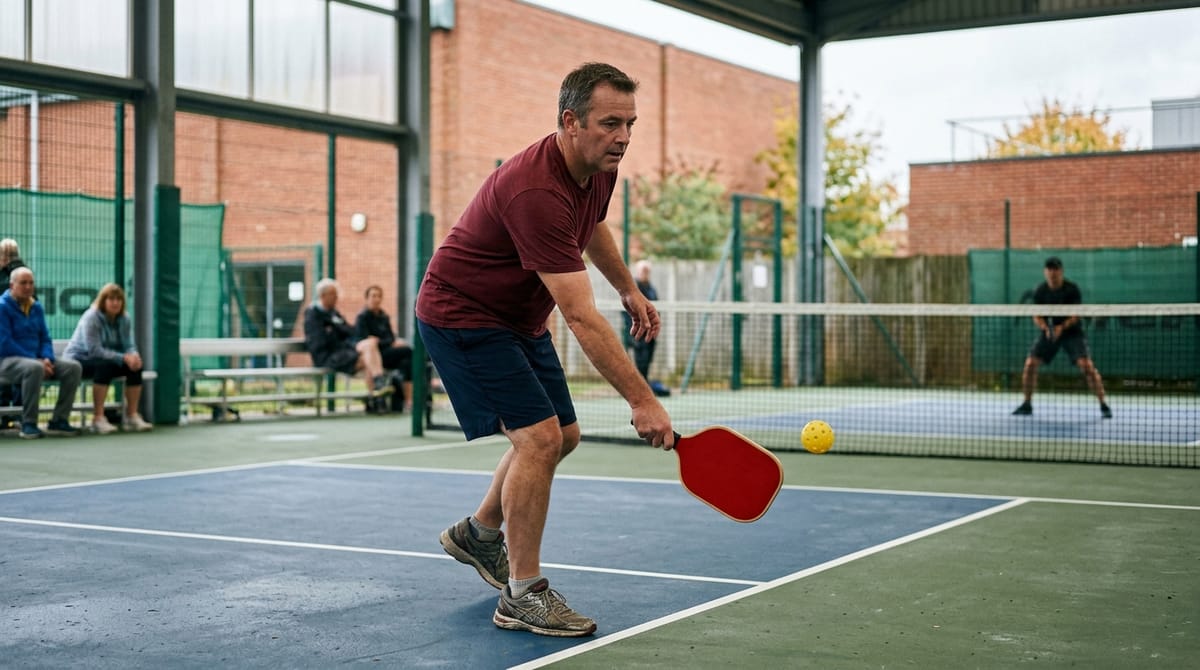
The pickleball serve is the most-rules-laden part of the sport - underhand contact, below-waist hits, drop-serve option, diagonal placement, baseline foot position, kitchen-clearance. Most beginners get faulted on the first 5-10 serves they take because they default to a tennis-style overhead motion. This tutorial covers the legal serve rules per the official IFP Rulebook + Pickleball England implementation, the two legal serve types (traditional + drop), the body positioning that prevents faults, and the deep-serve strategy that beats most beginner opponents.
What are the two legal serve types in pickleball?
The IFP rulebook permits two distinct legal serve types - the traditional 'volley serve' and the 'drop serve'. Both are widely used; choose by what feels most consistent.
Traditional volley serve. The classic underhand pickleball serve. Three legality requirements:
- The paddle face contacts the ball below the server's waist (more specifically: the navel level)
- The paddle head must be below the wrist at contact (i.e. the swing must be upward, not downward)
- The ball is struck out of the air without bouncing first
The traditional serve is the most-used at every level of pickleball, from beginner club play to professional tournaments. The constraints are real but become second-nature after 10-20 serves.
Drop serve. Added to the IFP rulebook in 2021 (initially provisional, made permanent in 2023). Requirements:
- The server drops the ball with one hand from any height (no toss)
- The ball must bounce on the playing surface before being struck
- The paddle contact can be at any height (the below-waist restriction does NOT apply)
- The drop must be 'without imparting force' - just release-and-let-fall, no throwing
The drop serve is easier for beginners because the below-waist restriction disappears - you can hit a more natural swing. Trade-off: less power than a well-timed volley serve. Most beginners are well-served (pun unavoidable) by starting with the drop serve, then transitioning to the volley serve once their technique stabilises.
How do you serve in pickleball, step by step?
Position yourself behind the baseline
Both feet must be on or behind the baseline at the moment of contact. Neither foot may touch the baseline itself or the area inside the court before the ball is struck. If you'd usually shuffle into a tennis serve, you need to stop short - this is the most common foot fault for converted tennis players.
Identify the diagonal service box
You serve diagonally across the court. From the right-hand service court, you serve into your opponent's right-hand service court (which is on your right when looking across the net). From the left-hand service court, into the opposite left. The serve must land in the diagonal box, clear the non-volley zone (the kitchen), and land inside the baseline.
Prepare the serve (volley OR drop)
For the volley serve: hold the ball in your non-paddle hand at about hip height, paddle in your dominant hand below your waist. For the drop serve: hold the ball in your non-paddle hand, ready to release it; paddle ready in any position. Announce the score before the serve (this is required at every level - 'three-zero-two' means your team has 3, opponent has 0, you're the second server).
Strike the ball
Volley serve: release the ball just enough to drop slightly, swing upward with your paddle below waist, contact the ball below navel level. Drop serve: release the ball, let it bounce once on the court (any height bounce is fine), then swing through it with any motion. The motion should be smooth and unhurried - rushed serves are the #1 cause of beginner errors.
Aim for depth, not power
Land the serve in the back third of the service box (closer to the baseline than the kitchen line). Deep serves push the receiver back, force them to hit a long-distance return, and prevent them from attacking. Shallow serves (close to the kitchen line) let the receiver step in and attack the third shot. Depth beats power at every skill level.
Track the return
Stay at the baseline after serving - DO NOT rush forward to the kitchen. Pickleball's 'two-bounce rule' requires the serve return + your third shot to both bounce before being volleyed. If you rush forward, you commit a volley fault on the return. Move forward AFTER you've hit your third shot.
What are the common serve faults and how do you avoid them?
Contact above waist (volley serve only). The most common volley-serve fault. If you can't reliably hit below the navel, switch to the drop serve - the height restriction goes away.
Paddle head above wrist at contact (volley serve only). A subtler fault - the umpire watches the paddle wrist relationship. Practice your serve in front of a mirror or with a slow-motion video; the paddle handle should point up at contact with the head pointing roughly horizontal.
Foot fault at the baseline. Either touching the baseline, stepping into the court before contact, or having a foot outside the imaginary side-line extension. Beginners often shuffle into the serve like tennis - stop. Plant your feet, then serve.
Ball lands in the kitchen (non-volley zone). The serve must clear the kitchen entirely - the kitchen line is part of the kitchen for serve purposes. A serve that lands on the line is a fault.
Wrong service box (cross-court fault). Serving into the same-side box rather than diagonal. Easy to fix once noticed; happens to beginners during the first few games when service rotation isn't yet automatic.
Foot fault on drop serve. The drop must be without imparting force - no throwing, no tossing. The umpire may call a fault for an obviously-tossed drop.
How does serving differ in singles vs doubles?
The serve mechanics are identical in singles and doubles. What differs:
Doubles serve rotation. Doubles uses a 'second serve' system - if your serve is faulted (either by you or by the receiver winning the rally), the serve passes to your partner. Only when BOTH partners have served-and-lost does the serve transfer to the opposing team. The exception: the very first serve of each game, where the starting team only gets one serve (this prevents the starting team from gaining an advantage). Score format: 'team-team-server' (e.g. '3-2-1' means your team has 3, opponents have 2, and you're the first server).
Singles serve rotation. Singles is simpler - each fault loses the serve to the opponent. Score format: 'server-receiver' (e.g. '3-2' means server has 3, receiver has 2).
Singles serve positioning. Even score (0, 2, 4, etc.): server stands on the RIGHT side of the centreline. Odd score: server stands on the LEFT. This is a common point of confusion - it's based on the SERVER's score, not the rally score.
How do you use deep-serve strategy?
Serve depth is the single biggest tactical factor in beginner-to-intermediate pickleball. The data is consistent across published analysis: deep serves (landing in the back third of the service box, within ~30cm of the baseline) win meaningfully more points than shallow serves.
Why depth matters:
- Receiver position. A deep serve forces the receiver to step back. Once they've stepped back, they can't comfortably attack the third shot - they're hitting from too far behind the kitchen line.
- Return depth. Deep serves create deep returns. Long-distance returns are harder to hit accurately and give you (the server) more time to set up the third shot.
- Court positioning balance. Pickleball is won at the kitchen line. Anything that delays the receiver's path to the kitchen is a tactical win. Deep serves achieve this passively.
The practical advice: aim for the back two feet of the service box on every serve. Even when you miss your target (and you will, frequently), the miss zone is still likely to land mid-court - which is better than aiming mid-court and missing into the kitchen line.
Skip power until your depth is consistent. A 35mph serve that lands mid-court is worse than a 25mph serve that lands deep. Power becomes useful once depth is reliable - usually after 3-6 months of regular play.
Frequently asked questions
Can I serve overhand in pickleball?
What's the difference between a fault and a let?
Do both singles and doubles use the same serve rules?
How fast can a pickleball serve be?
Where can I read the full pickleball rules?
Pickleball Rules Explained UK
Pickleball Scoring Explained
Best Pickleball Paddle for Beginners UK