Pickleball Doubles Strategy UK 2026
Pickleball doubles strategy UK 2026: kitchen-line race, third-shot drop, side-pairing, target the middle, communication, vs stronger pairs.
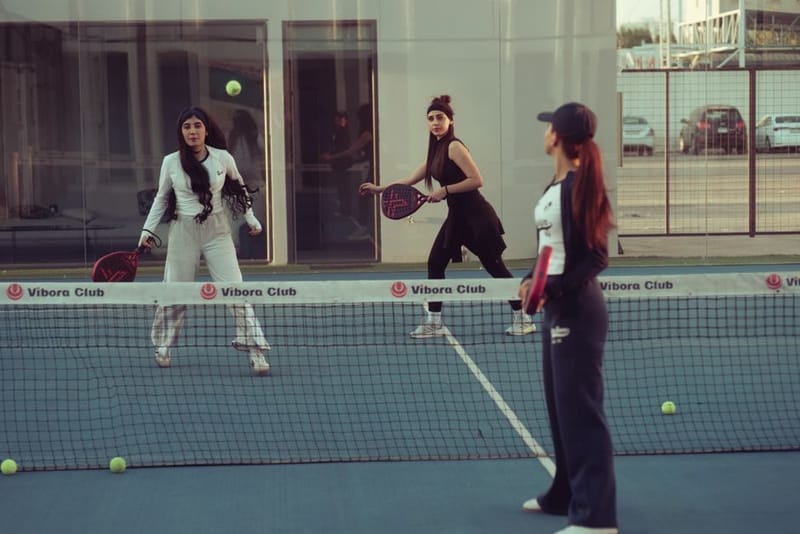
Most UK club pickleball players spend their time working on shots when they should be working on strategy. A 3.0 pair with sharp tactical habits beats a 3.5 pair with poor positioning consistently. This guide covers the five habits that separate club-level pairs from competitive 4.0+ pairs - all learnable in weeks, not years.
Why does getting to the kitchen matter so much?
The kitchen line is the high-value position in pickleball doubles. The pair that holds it wins about 70% of points across recorded tournament data. Three reasons:
- Shorter ball travel time. Volleys from the kitchen give opponents less reaction time than baseline drives.
- Wider angle of attack. From the kitchen line, you can hit sharper cross-court winners. From the baseline, those angles aren't available.
- Forces opponents to play dinks or lobs. The kitchen-line team controls the rally pattern. The baseline team is stuck playing reactive shots.
Therefore: every doubles point's primary goal is to get to the kitchen line and stay there. Most other tactical decisions follow from this.
What is the third-shot drop and why does it matter?
The third shot is the pivotal moment in a pickleball doubles point. The serving team starts at the baseline; the returning team is at the baseline; after the return both teams need to get to the kitchen. The shot that does this is the third-shot drop.
A third-shot drop is a soft arcing shot from the serving team's baseline that lands in the receiving team's kitchen. Properly executed, it gives the serving team time to walk forward to their own kitchen line while the returning team has to hit a low ball that can't be attacked.
Three keys to a good third-shot drop:
- Arc, not pace. Aim for ~5-7 feet over the net at peak. Topspin helps the dip but isn't essential.
- Land in the kitchen. Short kitchen = good. Anything past the kitchen line is attackable.
- Move forward as you hit it. Don't stand still admiring the shot. Your job after the third is to get to the kitchen.
The alternative is a third-shot drive - hard low drive at opponents' feet. Higher risk but useful when the third drop hasn't been working. Mix the two; opponents pattern-recognise.
How should partners pair sides?
Two right-handed players: put the stronger forehand on the left side (forehand points to the middle). Two left-handed: opposite. Right-and-left mixed: both forehands middle is the classic stack.
The middle is where 50-60% of balls go in pickleball doubles. The pair with stronger forehands covering middle wins more middle balls and forces opponents to hit through narrower wide angles. This single positional choice is worth a half-grade of skill against a comparable pair.
What is stacking and should I use it?
Stacking is the tactic of positioning both partners on the same side of the court for the serve or return, so that after the first two shots they shift into the preferred forehand-middle position regardless of the natural rotation.
Used when:
- One partner is significantly stronger on forehand and you want them covering middle constantly.
- Two right-handers want to keep the stronger forehand on the left side regardless of who's serving.
- You want to keep your strongest player at the kitchen earlier in points.
For UK club players climbing 3.0 to 3.5, stacking is a 3.5+ tactic. Master the basic side-pairing first; add stacking when you're playing tournament-level matches where the small positional advantage matters.
How should you and your partner move?
The single most important rule in pickleball doubles positioning: both partners move forward and back together. A straight line across the court at all times. Three corollaries:
- If your partner retreats to chase a lob, retreat with them.
- If your partner advances to take a short ball, advance with them.
- If you're at the kitchen and your partner is at the baseline, you have a problem. Adjust.
The classic 3.0 mistake is one player crashing the net while the other lingers behind. The gap between them is unplayable - any ball lands there. Fix this and you've upgraded the pair without changing a single shot.
Where should you target balls?
Three target zones in priority order:
- The middle. Forces opponents to call 'mine' or 'yours' - hesitation produces errors. The single highest-percentage target in doubles.
- The weaker player's backhand. Most club players have a worse backhand than forehand. Hit at it consistently and you wear them down. Identify the weaker side within the first 2-3 points.
- Opponents' feet at the kitchen. Balls at the feet of kitchen players force defensive returns. Can't attack from the feet position.
What to avoid: hitting to opponents' strongest stroke (you're feeding them); hitting wide where they have angle to return (cross-court drives in particular); hitting too hard (high-speed balls are easier to redirect at the kitchen than to chase).
What should you communicate in doubles?
Pickleball doubles communication is short, loud, and limited:
- "Mine" / "Yours": middle-ball call. Made before contact, not after.
- "Switch": side-change call after a lob retrieval.
- "Out": opponent's ball heading near baseline - tell your partner to let it bounce.
- "Back" / "Up": tell your partner they've drifted from kitchen line position.
- Between points: one tactical adjustment per point at most. "Target his backhand," "more lobs," "third drops not drives."
What kills doubles partnerships: complimenting every shot (distracting), arguing about losses (corrosive), giving technical advice during rallies (impossible to absorb). Focus on tactical patterns between points, not technique within them.
How do you handle a stronger opponent pair?
Three tactics for matching against a clearly stronger pair:
- Slow the game down. Stronger pairs win pace battles. Lots of dinks and drops force them to play patient pickleball where their advantage shrinks.
- Target the weaker of the two. Even 4.0 pairs have a relatively weaker player. Hit at them constantly.
- Lob more than usual. The lob is high-risk against equal opponents but reasonable against stronger opponents who don't expect it.
What not to do: try to out-hit them. Drives and pace plays against a stronger pair are usually points lost.
Frequently asked questions
Should beginners always go to the kitchen as fast as possible?
What is a third-shot drop in pickleball?
Should I drive the third shot or drop it?
Do I need to know stacking to play pickleball doubles?
How do I tell which opponent is weaker?
Is pickleball doubles different from tennis doubles?
The bottom line
For UK pickleball doubles pairs, the five habits to internalise are: race to the kitchen line, win the third shot with a drop, both partners move together, target the middle and the weaker backhand, and talk in short codes. These are tactical habits, not technique - they don't require a single new shot to apply. A pair that commits to all five sees visible improvement in 3-6 weeks and climbs from 3.0 to 3.5 levels through positioning alone.
Pair this strategy guide with our volley mastery guide and lob technique guide for the shot-specific complements. The rules of pickleball are governed in the UK by Pickleball England.