Pickleball Volley Shot Mastery UK 2026
Pickleball volley mastery UK 2026: kitchen-line technique, punch vs roll vs block volley, common mistakes, and live-point drills for UK club play.
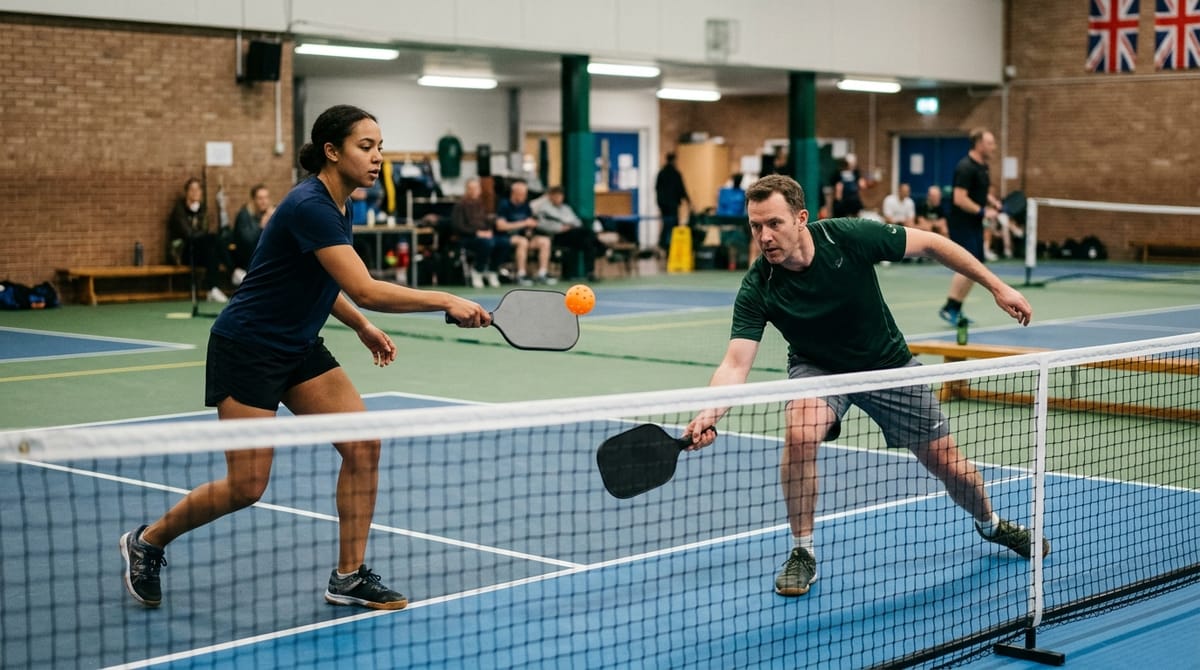
Volleys are the highest-frequency shot in competitive pickleball - more common than dinks, drives, or serves once both teams are at the kitchen. Master the three volley variants and you control the kitchen exchange; struggle with them and every fast-hands rally goes against you. This guide covers technique, decision-making, and the specific drills that produce visible improvement in UK club play.
What are the three pickleball volley types?
Most coaching breaks the volley into three functional variants:
- Punch volley: a short firm shot driven forward with a stable wrist and minimal back-swing. Used for finishing balls above the net at chest or shoulder height. The most common offensive volley.
- Roll volley: a brushed-up volley that imparts topspin. Used when you want depth and pace combined - the ball clears the net higher but dips into the back court. Excellent against passive defenders.
- Block volley: a soft volley with relaxed hands that absorbs the incoming pace and drops the ball just over the net. The defensive answer to a hard drive.
Choosing between them happens in the first quarter-second of the rally: high ball at chest height + punch; high ball above net but with time + roll; fast incoming drive at body or below net + block. The choice gets automatic with practice.
How do you set up at the kitchen line?
Your stance at the kitchen line determines how good your volleys can be. Five elements:
- Distance from the line: 6-12 inches back. Toes can't cross the line on contact - that's a fault. Standing right on the line gives you no margin for tracking dropped balls.
- Foot stance: Shoulder-width apart, slightly staggered (dominant foot back). Weight on the balls of the feet, knees soft.
- Paddle position: Up at chest height, paddle face pointing slightly forward. Ready position - not back, not down.
- Grip pressure: Medium-firm continental. Too tight = no touch; too loose = paddle face moves on contact.
- Eye line: Watch the opposing paddle and the ball off it. Tracking starts before your opponent contacts.
The ready position is the difference between players who can keep up with fast-hands exchanges and players who can't. Most 3.0 club players stand wrong at the kitchen and don't realise it.
How do you hit a punch volley?
The punch volley is the offensive default at the kitchen. Five steps:
- 1. Continental grip. Always - never switch grips at the kitchen.
- 2. Step forward into the ball if you have time. A small step puts weight behind the shot. If you don't have time, just contact in place - don't reach.
- 3. Compact back-swing. Paddle moves back to no more than the rear shoulder. Larger back-swings invite errors and slow the second shot.
- 4. Stable wrist through contact. The forearm drives the shot, not the wrist. Keep the wrist locked.
- 5. Short follow-through. Paddle finishes pointing toward the target, not the sky. The whole motion is forearm-and-shoulder, not wrist-and-arm.
Target: opponent's feet or backhand-side body. Both are hard to handle and force weak returns. Avoid hitting at chest-height where opponents can punch back through their own ready position.
How do you hit a roll volley?
The roll volley is the topspin variant - useful when you want depth and pace combined. Three differences from the punch:
- Paddle face slightly open at start, closing through contact. The face rotates downward across the back of the ball, generating topspin.
- Low-to-high swing path. The paddle travels up at about 30 degrees through contact. Steeper than the punch's level swing.
- Higher follow-through. Finish with the paddle higher than where it started, pointing toward your lead shoulder.
Target: back of the court, with the topspin causing the ball to dip and bounce away from the receiver. Higher net clearance than a punch but harder to attack on the return.
How do you hit a block volley?
The block volley is the defensive answer to a hard drive. Three differences from the punch:
- Soft hands. Loosen the grip slightly at contact. The paddle absorbs the incoming pace.
- Minimal forward motion. The paddle stays largely still through contact, working as a redirector rather than a striker.
- Open paddle face. Slight upward tilt at contact to lift the ball softly over the net rather than punching it down.
Target: the kitchen on the opposite side - drop the ball softly so opponents have to dig it up rather than attack it. The block volley resets a rally that's gone aggressive against you.
What are the most common volley mistakes?
Six errors UK club coaches see most often:
- Eastern forehand grip. Closes the face too much for the volley range. Stick with continental.
- Big back-swing. Anything more than the rear shoulder slows the second shot. Compact.
- Reaching for the ball. Step into it or accept the lost ball. Don't reach - lose your balance and the next shot is doomed.
- Wrist breaking at contact. A loose wrist produces weak floating volleys. Stable wrist; forearm drives.
- Standing too tight to the kitchen line. Toes-on-line gives no margin and trips foot-faults. 6-12 inches back.
- Watching the ball instead of the opponent's paddle. Tracking starts before contact. Watch their setup.
How do you practise pickleball volleys?
Four drills used in UK club coaching, in difficulty order:
- Volley-to-volley static drill (level 1): You and a partner stand at opposing kitchen lines, exchange volleys with no movement. 100 volleys without missing. Builds the basic motion.
- Targeted punch volleys (level 2): Partner feeds; you play 20 punch volleys to a marked target zone (cones in the back-court). Trains placement.
- Punch/roll/block decision drill (level 3): Partner mixes high/low/fast feeds. You play the correct volley variant for each ball. Trains decision-making.
- Live point with no-bounce rule (level 4): Standard pickleball points but no ball is allowed to bounce on your side once both teams are at the kitchen. Forces volley-only play; exposes weaknesses.
30 minutes per week of volley drilling produces meaningful improvement in 6-8 weeks for most club players. Pair with our pickleball lob guide and doubles strategy guide for the wider tactical picture.
Frequently asked questions
Why is the volley so important in pickleball?
What grip do I use for pickleball volleys?
How close should I stand to the kitchen line for volleys?
Should I jump or step into the volley?
How is a pickleball volley different from a tennis volley?
Can I volley from anywhere on the court?
The bottom line
For UK pickleball players, the volley is the single highest-return area for technique improvement. The fundamentals are simple: continental grip, 6-12 inches back from the kitchen line, paddle up in ready position, compact back-swing, stable wrist, short follow-through. The variants - punch for finish, roll for depth, block for reset - cover the three decision points you'll face at the kitchen.
Most club players improve faster by drilling volleys than by drilling any other shot. 30 minutes per week of structured volley work consistently produces visible improvement in 6-8 weeks; the volley-to-volley static drill at level 1 alone is enough to fix the worst kitchen-line habits.
The formal rules of pickleball, including the non-volley zone definition, are published by Pickleball England.