Around the Post (ATP) Shot in Pickleball, Explained
The around-the-post (ATP) shot in pickleball: what it is, why hitting it below net height is legal, when the ATP is on, and how to play and defend it.

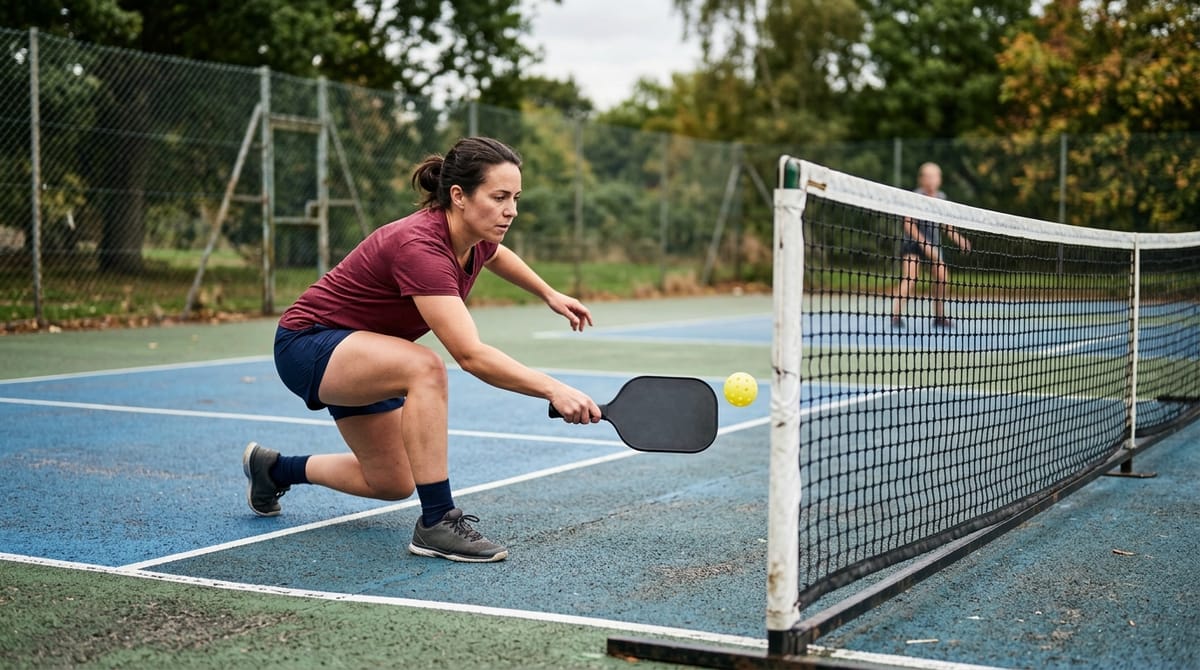
The around-the-post shot is one of the most satisfying winners in pickleball - a ball that curls around the outside of the net post and lands in court while your opponents watch it sail past where the net isn't. It looks like a trick shot, but it is a legitimate, repeatable weapon once you know when it is available and how to swing through it.
What is an around-the-post shot?
An around-the-post shot (ATP) is exactly what the name says: instead of hitting the ball up and over the net, you hit it laterally around the outside of the net post so it travels past the post and drops into the opposing court. Because the ball goes around rather than over, an ATP frequently travels well below the height of the net - sometimes only a few inches off the ground.
The shot only becomes possible when a ball is hit wide to you, outside the line of the sideline, so that the angle from your paddle back into the court runs outside the post. That usually happens off a sharply angled dink or drive that pulls you off the side of the court. In that moment, the straight line back into your opponents' court no longer crosses the net at all - it passes the post on the outside.
Is the ATP legal in pickleball?
Yes. This is the question every new player asks, and the answer is an unambiguous yes. The official rules of pickleball require the ball to land in the correct court; they do not require the ball to pass over the net or above net height. Going around the post is simply another legal path into the opponent's court. The sport's governing rulebook treats the ATP as a fully valid shot.
Three points keep an ATP legal:
- The ball must land in-bounds in the opposing court, like any other shot.
- You cannot touch the net or the post (or the net system) at any point - contact is a fault, exactly as it would be on any shot.
- Normal non-volley-zone rules still apply. The kitchen (the seven-foot non-volley zone either side of the net) does not extend beyond the sideline, so you are free to step outside the court to play an ATP - but if you volley the ball, your feet must not be inside the kitchen.
The ball is also allowed to be lower than the net when it crosses the plane of the post. There is no minimum height requirement, which is exactly why a low, flat ATP is so hard to defend.
When is the around-the-post shot on?
The ATP is an opportunistic shot, not one you set out to play. It becomes available when your opponent gives you a ball wide and angled enough that the geometry opens up. Look for it in these situations:
- Off a sharp cross-court dink. A well-angled dink that pulls you wide off the kitchen line is the classic ATP feed - the wider and lower it lands outside the sideline, the more the post angle opens.
- Off a wide, angled drive that pushes you outside the court near the net.
- When the ball is already heading past the post. If a ball is travelling wide and low and would pass outside the post anyway, redirecting it straight ahead is far easier than trying to lift it back over the net.
The key read is the ball's height and width: it needs to be low enough that lifting it over the net is awkward, and wide enough that a straight strike clears the post on the outside. If you have to manufacture the angle, the shot is probably not on - take the safe dink instead.
How do you hit an ATP?
Read the wide ball early
The moment you see a ball pulling you wide and low outside the sideline, recognise the ATP is on. Early recognition is most of the shot - you have very little time once you are moving sideways.
Move your feet outside the court
Take quick side steps so your body gets outside and slightly behind the ball. You want to strike it from beside it, not reaching across your body. Stepping fully outside the sideline is legal and necessary.
Swing flat and through the line of the post
Keep the paddle face square and swing on a flat, horizontal path aimed at the gap outside the post. Do not try to lift the ball - an ATP is driven low and straight, not looped.
Aim deep and at feet
Target the open court behind your opponents or straight at their feet. Because the ball stays low, a deep ATP is almost impossible to counter cleanly.
Recover to the kitchen line
After the shot you are stranded wide. Whether it wins the point or not, sprint back to your non-volley-zone position immediately so you are not exposed to the next ball.
How do you defend against an around-the-post shot?
Defending the ATP starts before it is hit. Once your opponent has a wide, low ball outside the post, you are usually too late - so the real defence is shot selection on the ball you send them.
- Do not over-angle your own dinks. The sharper and wider you dink cross-court, the more you hand your opponent the ATP angle. Keep dinks a little more central when you are unsure.
- Shade toward the sideline they are pulled to. If you have fed a wide ball, anticipate the ATP and move toward that sideline rather than holding the middle.
- Defend down the line, not over the net. An incoming ATP travels low and parallel to the net, so watch for it coming up the line and try to block it back rather than expecting a ball over the net.
- Accept the good ones. A well-struck ATP is frequently a clean winner. Do not over-commit chasing a perfect one - protect against the version your opponent shanks back into play.
Common ATP mistakes to avoid
Most missed around-the-post shots come from the same handful of errors:
- Trying to lift it. Players instinctively brush up to clear a net that isn't in the way. Swing flat and through.
- Taking the ATP when it isn't on. If the ball is not wide and low enough, forcing the angle sends it into the post or wide. The disciplined play is to dink it back.
- Touching the post or net in the follow-through - an automatic fault that wipes out the winner.
- Failing to recover. Even a great ATP leaves you out of position; ball-watching your own winner is how you lose the next rally.
Frequently asked questions
Is an around-the-post shot legal in pickleball?
Can the ball go below the net on an ATP?
Can I step outside the court to hit an ATP?
What's the difference between an ATP and an Erne?
How do I practise the around-the-post shot?

The Erne Shot in Pickleball, Explained
How to Dink in Pickleball: Technique and Drills
Pickleball Kitchen Rules: The Non-Volley Zone Explained