Pickleball Senior Players Guide UK 2026
Pickleball for senior UK players 2026: adapting play for 60+ age, injury prevention, paddle choice, senior leagues + venues.
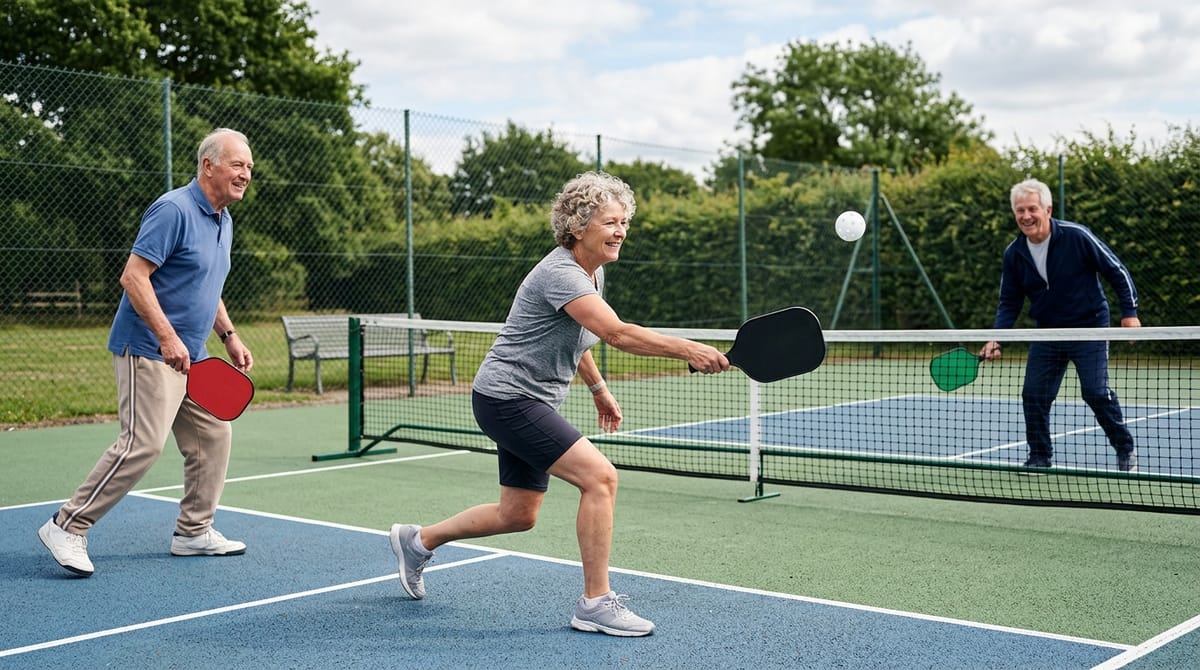
Pickleball has become a defining activity for UK 60+ players - this guide covers how to play smart, avoid injury, and connect with local senior communities in 2026.
Why pickleball suits 60+ players
Compared to tennis + squash.
Pickleball court vs tennis court:
- Pickleball: 20ft × 44ft (6.1m × 13.4m). Doubles uses entire court.
- Tennis: 27ft × 78ft (8.2m × 23.8m) singles. Much more court coverage required.
- Pickleball court covers ~30% of tennis court area - less running per point.
Ball + impact characteristics:
- Pickleball: 26-30g plastic perforated ball; max speed ~80mph but typical recreational 40-60mph.
- Tennis: 58-59g felt ball; max speed 120+mph; typical recreational 50-70mph.
- Lower ball mass + speed = less knee/shoulder stress on hard returns.
Rules favour skill over power:
- Non-volley zone (kitchen) prevents power-only baseline rallies.
- Underhand serve vs tennis overhand serve - less shoulder strain.
- Soft game (dinks) rewarded by rules + court geometry.
Adapting your game for 60+
Six smart adjustments.
- Choose lightweight paddle (7.0-7.5oz): less arm fatigue across long sessions + reduced wrist/elbow strain. See paddle weight guide.
- Doubles over singles: 50% court coverage; partner shares load. Most 60+ tournaments are doubles-only.
- Soft game emphasis: dinks + drop shots instead of power drives. Less high-impact movement; more strategic play.
- Avoid overhead smashes: rotator cuff strain is the #1 senior pickleball injury. Hit lobs as standard groundstrokes instead.
- Don't backpedal - turn and run: falls from backwards movement are the highest-risk pickleball injury for 60+ players. If a ball goes over your head, turn 90° + run forward, not backward.
- Warm up properly: 10-min light cardio + dynamic stretches before play. Reduces calf strain (the #2 senior injury) significantly.
Top injury risks + prevention
Senior-specific concerns.
1. Calf strain (most common):
- Cause: sudden lateral movements without warm-up.
- Prevention: 10-min warm-up; gradual intensity build; calf-strength exercises 2-3×/week.
- Recovery: 2-6 weeks rest typical.
2. Rotator cuff strain (#2 most common):
- Cause: overhead smashes + repetitive high-overhead serve attempts.
- Prevention: avoid overhead smashes; use the underhand serve technique correctly; rotator cuff strengthening exercises.
- Recovery: 4-12 weeks; sometimes requires physio.
3. Falls + fractures (lowest probability but highest severity):
- Cause: backpedalling on lobs; tripping on court boundaries; collision with partner.
- Prevention: turn + run instead of backpedalling; clear court boundary lines visible; communicate with partner ('Mine!' / 'Yours!').
- Recovery: varies hugely; potential 3-12 weeks for fractures.
4. Tennis elbow / wrist strain:
- Cause: excessive paddle weight + repetitive wrist motion.
- Prevention: lightweight paddle (7.0-7.5oz); proper grip technique; rest days between sessions.
- Recovery: 4-12 weeks; sometimes brace required.
5. Knee strain:
- Cause: sudden direction changes + lunging on hard courts.
- Prevention: proper footwear (pickleball-specific); knee braces if previously injured; modified squats to strengthen quads.
- Recovery: 2-12 weeks depending on severity.
Recommended equipment for 60+
Paddle + shoes + accessories.
Paddle (most important):
- Weight: 7.0-7.5oz lightweight.
- Even-balance or slightly handle-heavy (reduces wrist torque).
- Standard 5.0-5.5" handle length.
- Larger grip size (4.25" vs 4.0") if rheumatoid arthritis or grip strength concerns.
- Examples: Onix Z5 Graphite (7.6oz), Selkirk SLK Halo Control (7.2oz), Engage Encore EX 6.0 Lite (7.4oz).
- Budget: GBP 65-150 typical.
Shoes (second most important):
- Pickleball-specific or court tennis shoes (lateral support).
- AVOID running shoes - they roll ankles on lateral movements.
- Examples: K-Swiss Ultrashot 3, ASICS Gel-Court Speed.
- Budget: GBP 80-130.
Eye protection (strongly recommended): GBP 25-65. See eye protection guide.
Knee brace (if previous knee issues): GBP 15-50.
Compression sleeves (elbow/calf): GBP 8-20 each.
UK senior pickleball leagues + venues
Where to play.
Pickleball England Senior divisions:
- 50+ / 60+ / 70+ age divisions at national tournaments.
- Beginner-friendly divisions at most events.
- Pickleball England membership: GBP 20-40/year.
- Registration: pickleballengland.org.uk.
LTA Pickleball Masters:
- LTA-affiliated competitions for 35+ / 50+ / 60+ players.
- Often integrated with tennis club events.
- Search 'LTA Pickleball events' at lta.org.uk.
U3A (University of the Third Age):
- Many UK U3A groups (~1,000 across the country) have pickleball sessions.
- Recreational + social rather than competitive.
- Local membership: typically GBP 10-25/year.
- Find local group: u3a.org.uk/find-a-group.
Community centre + leisure centre programmes:
- Most UK local authorities now offer pickleball sessions (typically GBP 4-8/session).
- Senior-specific or all-ages classes; check your council leisure listings.
NHS Active 60 programme:
- Pickleball recommended in NHS Active 60 + Active Ageing campaigns.
- Some sessions subsidised for over-60s.
Health benefits documented
Why playing is worth the effort.
Documented health benefits of pickleball for 60+ players (research from UK Chief Medical Officers physical activity guidelines + similar US studies):
- Cardio fitness: moderate-intensity activity meets weekly NHS recommendation of 150min/week.
- Balance + fall prevention: lateral movement training reduces fall risk 15-25%.
- Bone density: weight-bearing activity helps maintain bone density (especially for post-menopausal women).
- Cognitive function: doubles play + tactical thinking shown to maintain cognitive function in 60+ players.
- Social engagement: doubles play + club community reduces isolation - a documented mortality risk factor for 60+ adults.
- Mood + mental health: 60-min sessions improve mood for 24-48 hrs post-play.
Pickleball is one of the few sports where playing into 80+ remains realistic. The lighter ball, smaller court + doubles format mean players can maintain skill + enjoyment well past peak athletic years.