Pickleball Doubles Partner Chemistry UK 2026
Pickleball doubles partner chemistry UK 2026: communication, lefty-righty pairing, style matching, finding a partner.
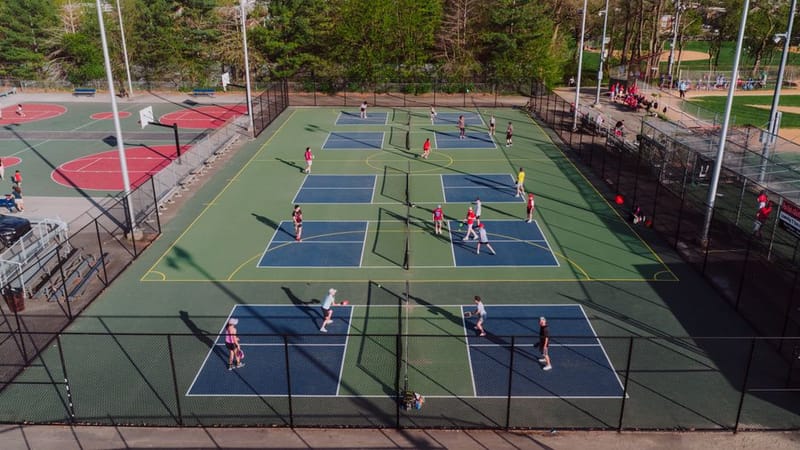
Doubles pickleball success depends as much on your partner as your own game. This guide covers how to find a good partner, what chemistry looks like, and how to develop it.
What 'partner chemistry' actually means
Six observable factors.
Pickleball partner chemistry isn't mystical - it's a set of observable behaviours:
- Clear shot-claim communication: each ball going down the middle gets called 'Mine!' or 'Yours!' instantly. Without this, both players hesitate + both miss.
- Shared court positioning instincts: when one moves to net, the other moves with them. When one drops back, the other does too. The 2-player line moves as a unit.
- Complementary play styles: one banger + one finesse > two of either. The team can execute both power + soft games.
- No blame culture: missed shots don't trigger criticism mid-game. Discussion happens between games.
- Compatible competitive intensity: a hyper-competitive player + a chill recreational player = friction. Match intensity to enjoy each other's company.
- Predictable shot patterns: knowing your partner's likely shot choice helps you cover the right zone. Develops over 10-20 sessions together.
Pairing geometry - lefty + righty advantage
Where forehands point.
Lefty + righty doubles pair (typically optimal):
- Both partners' forehands point toward the middle of the court.
- The middle of the court is the most dangerous shot zone in doubles - this geometry maximises forehand coverage.
- The 'middle' shot that splits two righties (or two lefties) is now a forehand for both lefty + righty.
- ~5-10% of UK pickleball players are left-handed - finding a lefty partner is a real edge.
Two-righty pair (standard):
- One partner's backhand sits at court middle.
- Need to agree pre-point which partner takes the middle backhand attempt.
- Typically: the player closer to the net's backhand zone takes it.
Two-lefty pair (rare):
- Mirror of two-righty pair. Both backhands at middle.
- Same logic + court positioning as two-righty.
Style pairing - avoid duplicating weakness
Complementary games.
Pair to cover different strengths:
- Power baseline + finesse net: optimal. Power player attacks; finesse player resets soft. Covers both styles.
- Tall reach + quick lateral: tall player wins overheads + lobs; quick player chases short balls.
- Patient + aggressive: patient player resets dinks; aggressive player puts away weak returns.
Avoid duplicate weaknesses:
- Two pure power players: rallies devolve to hit-for-power; no soft game available; team loses to patient opponents.
- Two pure finesse players: lacks put-away firepower against aggressive opponents.
- Two slow-court-coverage players: gets attacked deep + lobbed over.
Common UK club doubles pairs that work:
- Experienced player + improving player: experienced player covers more court + sets up easy puts-away for newer partner.
- Tactical player + power player: tactical player drops, power player attacks pop-ups.
- Two competitive but humble players: both play percentage shots + accept missed shots gracefully.
Finding a pickleball partner in the UK
Where to look.
Pickleball England club listings:
- ~150 UK clubs registered with Pickleball England.
- Find local club: pickleballengland.org.uk/clubs.
- Club sessions typically rotate partners - good for identifying chemistry.
LTA Pickleball clubs:
- LTA-affiliated tennis clubs increasingly offer pickleball sessions.
- Search lta.org.uk for local club.
U3A groups (60+ players):
- ~1,000 UK U3A groups; many have pickleball sessions.
- Find local group: u3a.org.uk/find-a-group.
Local Facebook + WhatsApp groups:
- 'Pickleball [city] UK' Facebook groups exist for most major UK cities.
- Posting 'looking for doubles partner, 3.5 level' gets responses.
Open play sessions + ladder leagues:
- Most clubs run open play 1-3×/week where partners rotate.
- Ladder leagues track player ratings + suggest similarly-rated partners.
Tournament partner-matching:
- Pickleball England tournaments offer partner-match service for solo entrants.
- Less ideal than playing with a regular partner but available.
Developing chemistry over time
What 20 sessions together looks like.
Sessions 1-5 with a new partner:
- Calls awkward, court positioning sloppy, missed shots from confusion.
- Focus: agree shot-calling convention; review after each game.
Sessions 6-15:
- Calls become quicker; positioning settles into patterns.
- Focus: identify each player's strengths + start trusting partner's reads.
Sessions 16+:
- Communication often non-verbal (eye contact + hand signals).
- Positioning automatic; shot calls only on ambiguous balls.
- Predictable shot patterns - you know what your partner will do next 70%+ of the time.
Investment vs. return:
- 20 sessions = ~30-60 hours of play together. Roughly 3-6 months for a 1-2 sessions/week player.
- The chemistry gain is equivalent to ~0.5-1.0 NTRP rating points.
- If you're committed to tournaments, this is the highest-ROI investment outside of paid coaching.
Mid-match dynamics
Sustaining good chemistry.
- Compliment good shots: 'Great drop!' / 'Nice get!' reinforces positive momentum.
- Acknowledge your own mistakes: 'My fault, took yours' shows accountability.
- Don't critique partner's mistakes mid-game: discussion happens between games.
- Use positive timeouts wisely: when opponents are on a run, calling a timeout to reset is normal + healthy.
- Trust your partner's reads: if they call 'mine', let it be theirs; second-guessing breaks rhythm.
- Stay positive through losses: doubles is about team momentum; negativity is contagious.